Renzora Engine
Powered by Rust & Bevy 0.18
The first fully-featured game engine built on Bevy — a complete visual editor, scripting, physics and real-time rendering, engineered in Rust and fully open source.

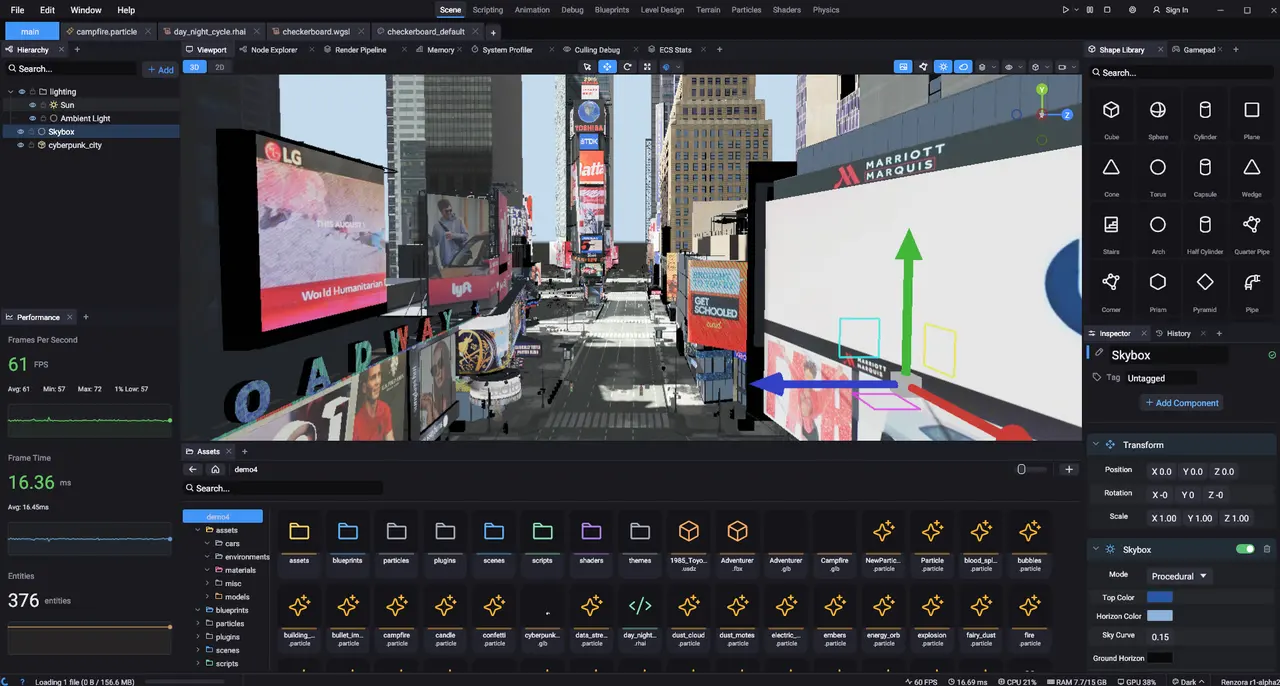
Build real-time 3D worlds in one professional editor — hierarchy, transform gizmos, a reflection-driven inspector and a live performance panel, side by side.
Eight systems, one engine
Not a thin wrapper — a full production toolkit, with almost every feature shipping as its own plugin.
Scene Editor
Dockable panels, nested hierarchy, and a reflection-driven inspector with custom components.
Scripting
Lua 5.4 and Rhai chosen by file extension, plus visual Blueprint node graphs.
Plugin System
Almost every feature is a plugin — hot-load cdylibs into plugins/ with renzora::add!.
Physics
Rigid bodies, colliders and queries powered by the Avian physics engine.
Materials & Shaders
Node-based PBR material graph, custom WGSL, and 50+ post-process effects.
Ember UI
Build game and editor UI from .html templates with reactive bindings.
Cross-Platform
Export to Windows, Linux, macOS, Android, iOS and the Web.
Debugging
An 11-panel debugger — profiler, memory, ECS, render and physics stats.
A complete engine, engineered in Rust
No glue scripts, no bolted-on runtimes. Every system below ships today, built on Rust and Bevy 0.18.
A reflection-driven editor that understands your types
Compose scenes across up to four viewports with transform gizmos, organize everything in a nested hierarchy, and edit any component in an inspector generated straight from your Rust types. Derive Inspectable on your own structs and they show up — fully editable and serialized with the scene.

The inspector stacks a World Environment's components — transform, directional light, volumetric god rays and TAA.
Bevy's renderer, tuned for beautiful real-time scenes
Physically based shading, dynamic lighting and Lumen global illumination render your worlds as you build them. Light a moody neon cafe, a rain-slick street or a daytime cityscape and iterate live in the viewport — what you see is what ships.

A Parisian cafe street rendered in the viewport, with a single scooter selected and warm atmospheric lighting.
Script in Lua, Rhai or visual Blueprints
Write gameplay logic in a built-in editor with full syntax highlighting. Renzora picks the runtime from the file extension — Lua 5.4 or Rhai — and visual Blueprint node graphs cover the same ground without code. Hook into lifecycle callbacks like on_update and drive entities directly.

The built-in editor with several Lua scripts open — car_physics.lua handling steering, throttle, brake and handbrake input.
Almost everything is a plugin
Renzora is built from roughly 187 workspace crates, and nearly every feature — from the material graph to the audio mixer — ships as its own plugin. Distribution plugins are hot-loadable cdylibs: drop one into plugins/, register it with renzora::add!, and it appears in the editor.

The Add Panel browser — dockable panels grouped by Blueprint, Debug, Audio, Material, Particle, Scripting, Shader, Terrain and more.
Populate your world, then bring it to life with Avian
Spawn lights, cameras, terrain, splines and 2D nodes from one searchable Add Entity menu — physics bodies included. The Avian physics engine drives rigid bodies, colliders and queries, with a dedicated physics debug view for when you need to see the simulation.

The Add Entity menu — lights, cameras, terrain, 2D nodes and physics, all in one searchable list.
Author PBR materials as a graph — or drop down to WGSL
Wire texture, normal-map and math nodes into a Surface Output exposing base color, metallic, roughness, normal, emissive, AO, clearcoat, anisotropy and more. Need full control? Write custom WGSL shaders and stack over fifty post-process effects on top.

Sample Texture and Sample Normal Map nodes wired into a full PBR Surface Output.
Markup-driven UI for your game and the editor itself
Renzora's Ember system builds interfaces from .html templates with reactive double-brace bindings — the same system powers in-game screens and the editor's own panels. Design a match lobby or a HUD visually, point it at an HTML template and a UI layout, then bind it to scripts.

The in-engine UI builder editing a match-lobby screen, with HTML Template and UI Layout exposed in the inspector.
Eleven debug panels, a console and a command palette
Profile in real time with FPS, frame timing, memory and render stats, then dig into ECS stats, physics and culling debug, Lumen GI and scripting diagnostics — eleven panels in all. A filterable console with categorized logs and a command palette round out the toolkit.

Live diagnostics docked across the bottom — Performance, System, Render Stats, Memory, Physics and Camera debug, with graphs.
One project. Six platforms.
Build once and export to desktop, mobile and the browser — Windows, Linux, macOS, Android, iOS and the Web via WebAssembly.
More of the toolkit
Hierarchy, audio mixing, the Hub Store, the asset browser and the console — every panel is real and dockable.


Build it in Renzora
Download the open-source engine and spin up your first scene in minutes.